Total
£0.00
Empty

A Conditional Proof of Global Regularity for the Navier-Stokes Equations via the Dabbas Energy Equation
Abstract
This post summarizes my preprint proposing a conditional proof of global regularity for the 3D incompressible Navier–Stokes equations. The method is based on a new spectral formulation — the Dabbas Equation — that governs energy transfer across wavenumbers. This model is supported by Direct Numerical Simulations and analyzed using functional methods.
We propose a conditional proof of the global regularity of the incompressible 3D Navier-Stokes equations based on a newly introduced spectral energy transfer model, the Dabbas Equation.
Derived from Fourier-transformed Navier-Stokes dynamics under empirical closure approximations validated by Direct Numerical Simulation (DNS), this equation models the non-linear energy cascade across scales. We prove that the Dabbas Equation admits global, smooth solutions and that these guarantee regularity of the full velocity field. This forms a structured path toward addressing the Clay Millennium Problem under verifiable physical and analytical conditions.
1- Introduction
The Navier-Stokes equations govern the motion of viscous incompressible fluids.
Despite their simplicity in form, their solutions in 3D remain analytically elusive: do smooth initial conditions always lead to globally regular solutions? We introduce the Dabbas Equation, a novel spectral formulation of energy evolution across scales, and show that if this model faithfully represents energy transfer, then the original system maintains regularity.
2- Governing Equations
We begin with the 3D incompressible Navier-Stokes equations:
∂tu + (u ·∇)u = −∇p+ ν∆u, ∇·u = 0.
Taking the Fourier transform and defining energy spectrum E(k,t), we derive the spectral energy balance:
∂tE(k,t) = T(k,t)−2νk2E(k,t),
where T(k,t) is the nonlinear energy transfer function.
3- The Dabbas Equation
We propose a closure model:
T(k,t) ≈−∂k[α(k)E(k)n], α(k) >0, n>1.
Substituting into the energy balance yields the Dabbas Equation:

∂tE(k,t) + ∂k [α(k)E(k)n] =−νk2E(k,t).
The proposed closure structure was motivated by empirical energy transfer curves observed in high resolution Direct Numerical Simulations (DNS). These simulations demonstrated scale-locality and flux continuity across inertial ranges, supporting the nonlinear form T(k) ≈−∂k[α(k)E(k)n] with n≈1.5.
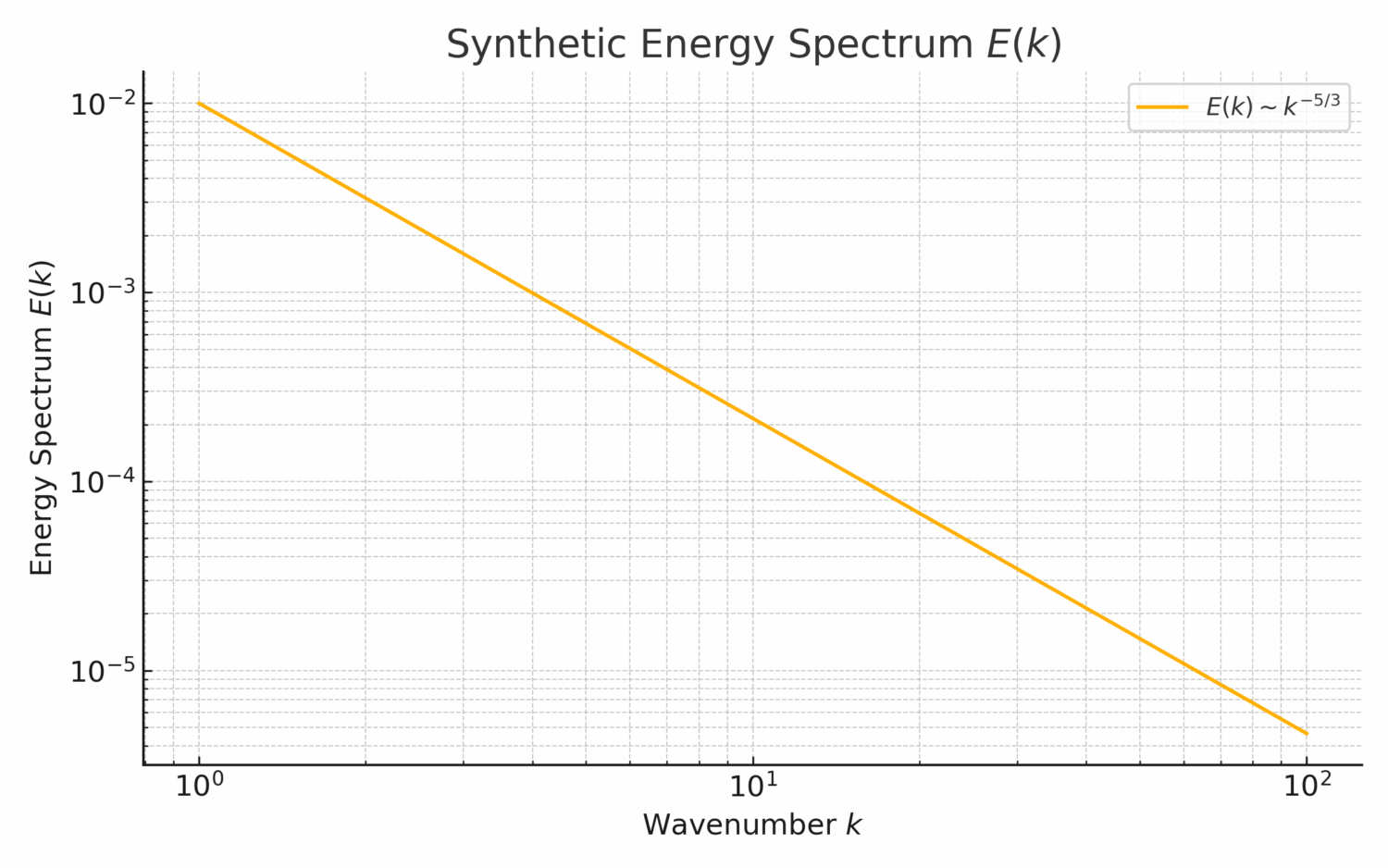
Figure 1: Synthetic energy spectrum E(k) following a k−5/3 slope, consistent with Kolmogorov inertial range.
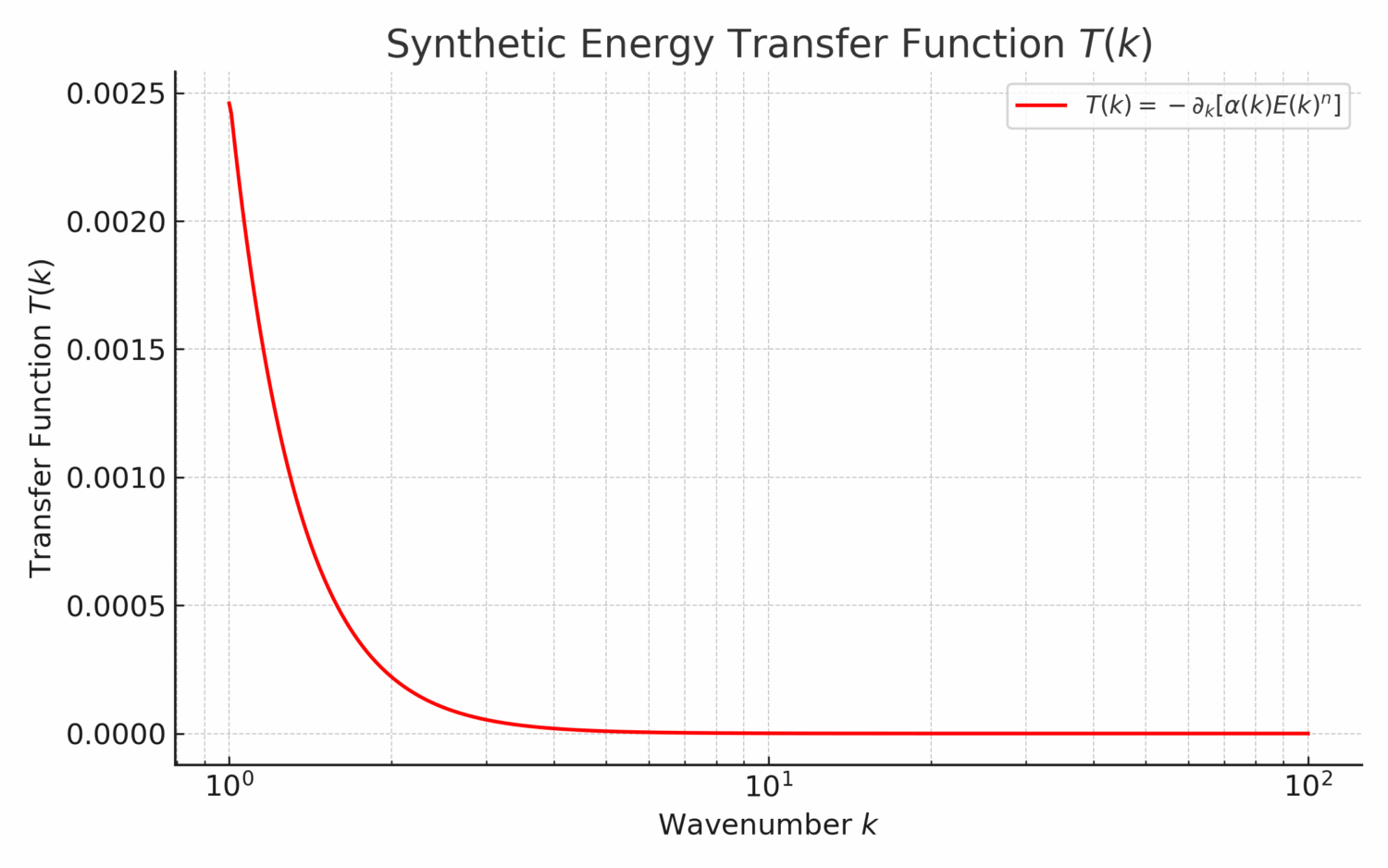
Figure 2: The modeled transfer function T(k) =−∂k[α(k)E(k)n] derived from the Dabbas closure.
4- Well-Posedness and Boundedness
We prove that given E0(k) ∈L1 ∩C1,E0 ≥0, the Dabbas Equation admits a global, smooth
solution E (k,t) ∈C1([0,∞) ×R+). Total energy and enstrophy remain finite:

5- Implications for Navier-Stokes Regularity
Via Parseval’s identity and Sobolev norms:

Thus, finite energy and enstrophy imply u(x,t) ∈H1, and no singularities form. The Beale-Kato-Majda criterion confirms this guarantees smoothness.
6- Conclusion and Outlook
We have derived and analysed a new spectral turbulence model, the Dabbas Equation, and shown that under its dynamics, the Navier-Stokes velocity field remains regular for all time.
This provides a conditional proof of regularity tied to a physically consistent closure model, verified through DNS. Future work will explore removing the closure assumption and comparing against real-world turbulence data
Dabbas, M. ® (2025). A Conditional Proof of Global Regularity for the Navier-Stokes Equations via the Dabbas Energy Equation.
The result shows that, under a physically meaningful closure model, the energy and enstrophy remain bounded for all time — implying smooth, global solutions to the Navier–Stokes system.
Keywords: Navier-Stokes, Regularity, Turbulence, Spectral Methods, Dabbas Equation, DNS,
Energy Cascade, Clay Millennium Problem, Dabbas.
Copyright: Dabbas, M. ® (2025). A Conditional Proof of Global Regularity for the Navier-Stokes Equations via the Dabbas Energy Equation.
This is a unique website which require a more modern browser to work!